Best gaming TVs of 2026
We are now in the middle of 2026, most TVs have now been reviewed by Rtings and we just had the King of TVs event.
So I would like to give you my take on the best gaming TVs for 2026. The ultimately best gaming TV and the best upper midrange gaming TV.
First I will explain why you should always choose an OLED display for gaming.
1. Why OLED, not LCD
The best gaming TV is an OLED display because of its 8.3 million individually controlled pixels. No amount of back light dimming zones or mini LEDs on LCD, LED or QLED TVs can match this.
OLEDs pixel level control means;
- Superior Motion Clarity and Detail Retention
- Better perceived input-lag
- Perfect black levels
- Small bright high-lights pop
I explain this in further detail in my article "Best Gaming Display - OLED vs LCD".
Superior motion clarity and detail retention and better perceived input-lag are aspects that many TV reviewers don't mention, because they focus on the TVs being used for watching movies. But it's important aspects for gamers, when choosing a TV for gaming.
OLED's near-instantaneous pixel response times (typically ~0.1ms or less) mean pixels switch states almost immediately, resulting in virtually no motion blur or ghosting. LCD update their pixels up to 40x slower. We see enemy movements faster and there is more detail retained when objects move on screen on an OLED than on LCD displays.
Faster pixel response time also mean we see the effect of our mouse and controller movements faster on an OLED - it gives lower perceived input-lag than on LCD displays.
Better black levels, with no blooming is very important for gamers. We often game in a dark room (that's how HDR is meant to be experienced) and here only OLED have true black levels. Even the best LCD TVs still don't have perfect black levels in a dark room. Many game scenes are at night, in caves etc., so we can really take advantage of OLEDs infinite contrast when gaming.
Small highlights that pop in dark scenes is something LCD TVs can't show as good as OLED TVs, because their back light systems dim smaller bright objects on a black back ground to reduce blooming and to keep black levels as low as possible. That's important for bright stars in a dark sky, torches in caves or at night, bright neon lights at night in cities etc.
The only place where LCD TVs might have an advantage, is if you game in a very bright room with lots of Sun light. It's because LCD TVs can get much brighter, especially full screen. But then nothing really matters, because you go against how HDR is supposed to be experienced. We can't see detail in shadows in a bright room, and we lose HDR pop in a bright room.
2. The ultimate gaming HDR TV of 2026: Samsung S95H (QD-OLED)
The yearly King of TVs shootout was just held and here the QD-OLED s95h won over the WOLED LG G6.
QD-OLED is the best OLED display technology we have. It does not rely on the extra white subpixel that WOLED still does. It makes the TV true RGB and it seems the display Samsung has made, is simply less complex than the latest WOLED panels, that gives it some advantages.
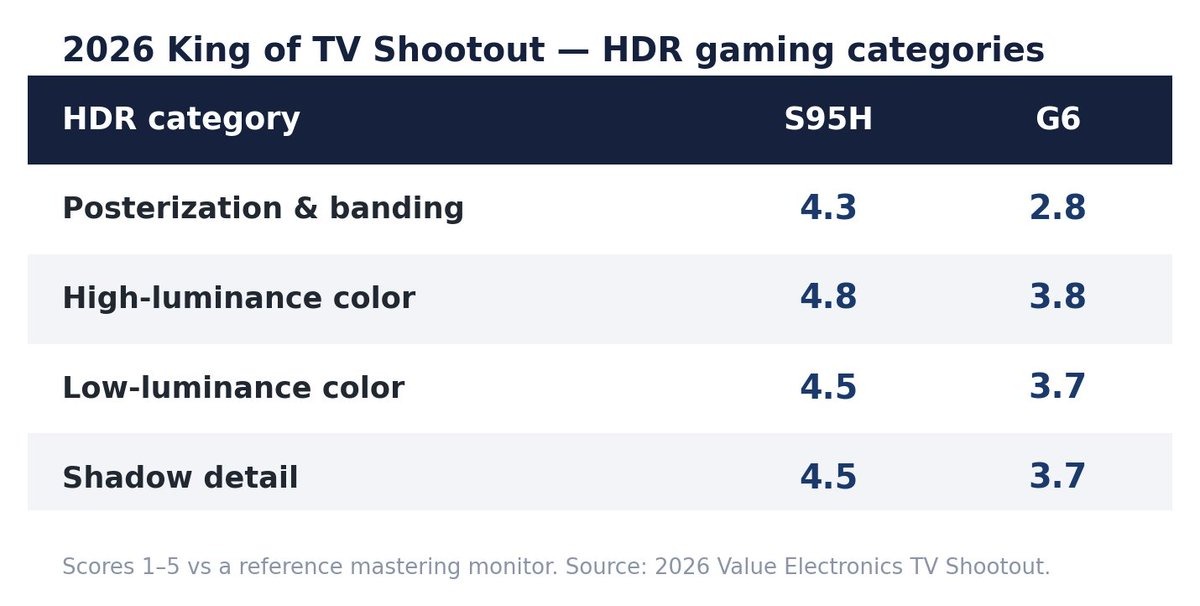
The picture below show the HDR categories where Samsungs QD-OLED has significant advantages in this years TV shootout.
We see that s95h scores significantly higher in all these categories than G6. That doesn't mean G6 isn't an amazing gamer TV overall. It is. It just means s95h is better.
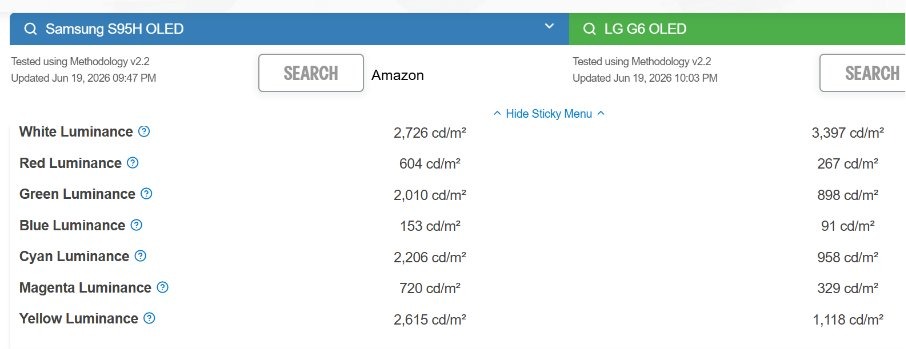
High Color Volume: We gamers push peak brightness to the TVs limits in all our games. So high luminance color - the ability to show saturated colors at these high brightness levels, becomes important. Here QD-OLED is 2-3x better than the best WOLED TVs. Below we can see Rtings test of saturated color brightness on s95h and G6.
Banding: Banding is important for gamers when we are in big open worlds with skyboxes and bright city skylines. Games often add game bloom to big bright light sources, and here banding is typically very visible, if a TV has lots of banding.
Shadow Detail: The better handling of detail just above black, is important too for gamers, because games take place in so many dark scenes from dark caves to dark nights.
There are 3 specific things I want to also highlight, to why QD-OLED is better than WOLED:
- No visible dithering. Samsungs QD-OLED TV panels don't use dithering, like LG G6 does. It's a near-black dither pattern that shows up in dark content on WOLED panels. It's not visible from normal viewing distances, but we gamers often sit closer than movie viewers, if we want more immersion or sit in a desktop setup. It has been improved on G6 over G5, but it's still there.
- Eye comfort. Over long sessions, QD-OLED is widely reported to be easier on the eyes than WOLED. I have this experience myself. I never have any eye issues with my QD-OLED TV blasting 2000 nits into my eyes in a dark room for long gaming sessions. I had that with a WOLED LG CX.
- Cleaner Game Mode passthrough. Samsung's TVs, including in Game Mode uses less sharpening, edge enhancement and noise reduction than LG WOLED displays. We gamers, especially PC gamers, want to control sharpness etc. on the game level. The TV must do as little as possible.
Dolby Vision - HDR 10+: Samsung TVs don't support Dolby Vision. In my opinion it's a non-issue. Don't disregard a gaming TV just because it's not supporting Dolby Vision. This is the conclusion I made when looking at this in my article about HDR10+ and Dolby Vision in games.
3. Best upper-midrange gaming HDR TV: LG C6 / C6H
In 2025 the Samsung S90F QD-OLED was my pick for best upper midrange gaming TV. In 2026 it's WOLED — because Samsung no longer guarantees a QD-OLED panel in its midrange. The S90H ships WOLED in the US and UK; only rare markets get a QD-OLED variant. (Model number: T or F = QD-OLED, E = WOLED.)
So for a new upper midrange set, my pick is LG:
- LG C6 (42–65"): upgraded C5-generation WOLED panel.
- LG C6H (77", 83"): the flagship G6's Primary RGB Tandem 2.0 panel (a touch less bright), with Hyper Radiant Color.
The LG C6 uses an upgraded panel versus the C5. It can output up to 1470 nits versus C5s 1280 nits in game mode, according to Rtings.
Especially the LG c6h looks to be an amazing gamer TV to me. It comes with the new panel. It's close to G6 in brightness and saturated color brightness. It does not have the G6s new panel coating, that is better at handling reflections, but this doesn't matter in a dark room. It only matters if you game during daytime.
An alternative could be last years model, Samsung S90f, in its QD-OLED panel variant, if you can get one. I would still choose the S90f, over the c6 but not over the c6h.